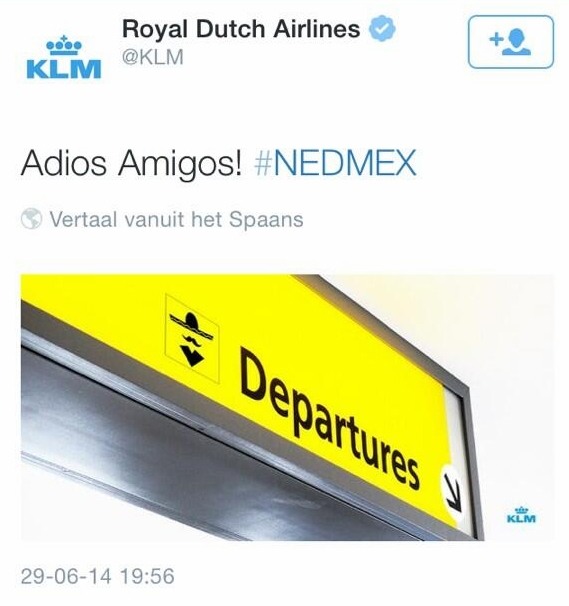
 Topical content is the new magic formula for marketing and communications professionals seeking to engage audiences with their brands. A timely, well-placed joke or pun, perhaps combined with a strong visual or text, can work wonders. The World Cup in particular brings one example after another. Yet despite many enjoyable ideas, such as those from HEMA, humour remains subjective. A brand can easily get it wrong, and people will let it know, even if it is one of the Netherlands’ best-loved brands.
On Sunday evening, after the Netherlands knocked Mexico out, KLM thought it had another winning line: “Adios Amigos!” Dutch Twitter users could laugh at it, but Mexicans were less amused. A storm of criticism and indignation followed, amplified by Gael García Bernal’s angry response, which he later deleted and apologised for. KLM subsequently apologised, stressing that it had not intended to hurt anyone.
Under fire
It is remarkable how much a topical tweet can, or cannot, set in motion. According to KLM’s own figures, 92,000 Twitter users around the world criticised the joke. Negative reactions came mainly from abroad. Although the Netherlands was also tweeting heavily, positive sentiment dominated at home. Much of the domestic criticism concerned deleting the tweet. GeenStijl had already called KLM cowardly, a description Dutch Twitter users then repeated. Otherwise, many in the Netherlands continued to consider it a “legendary” tweet, as the word cloud covering reactions from that evening onwards shows.

KLM and #NEDMEX, Sunday 29 June to Monday 30 June. Source: Coosto.nl.
On Tuesday afternoon, 1 July, KLM reluctantly published an English blog post acknowledging its mistake. It was clearly aimed at the rest of the world, which did not necessarily appreciate blunt Dutch humour, and framed social media as a place to learn by making mistakes. This move again received positive reactions, represented by the green line in the analysis.
National pride and a sport followed passionately across the country make topical content an attractive way to win consumer attention. There are plenty of Dutch examples where it went wrong and Twitter reacted harshly: #nosje, #yolanthetweet and #quinty, as well as Nicolette van Dam during this World Cup, whose tweet about Colombia led to her stepping down as a UNICEF ambassador. Perhaps the current World Cup excitement played a part, but KLM momentarily forgot its established international audience. That audience was quick to point out that Dutch humour does not necessarily travel, and that jokes and defeat are not always a good combination.
Interested in the tweets, sentiment analysis and full picture of the KLM #NEDMEX story? Take a look at our Coosto dashboard, created specifically to follow the controversy.
Trevor
More news ›