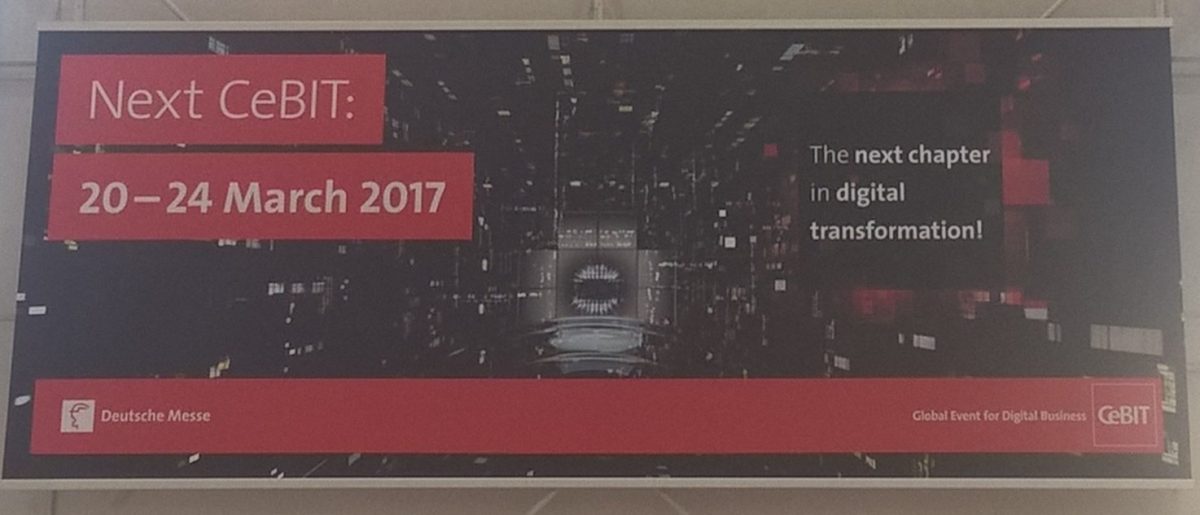
I have been a regular visitor to CeBIT for years. For my colleagues and me, it is an ideal opportunity to deepen our knowledge of ICT and consumer electronics, discover developments and visit clients such as Microsoft, Polycom and AVM for updates on products and technology. There is also time to look around and explore new business opportunities.
As one of the world’s largest ICT fairs, CeBIT has faced challenges in recent years, from declining visitor numbers to major exhibitors withdrawing. You might see those as reasons to stop attending. I disagree. This year, CeBIT repositioned itself as a platform for digital transformation, moving beyond its traditional computer-fair image.
The new approach suits it well. Visitor numbers rose, major companies including G DATA returned, and I was enthusiastic too. In the spirit of sharing knowledge, here are the three biggest trends I noticed.
1. Security is hot
As a security enthusiast, I had plenty to enjoy in Hall 6, dedicated entirely to organisational cybersecurity. Major names included Sophos, G DATA, Kaspersky, Symantec and Gemalto. Alongside established providers, companies from southeastern Europe, particularly Romania and Slovenia, were becoming more prominent.
Several exhibitors focused heavily on the forthcoming European GDPR. Figures about the growing number of cyberattacks were everywhere. Hall 6 was clearly one of the busiest halls: security was attracting attention.

One striking feature was the importance these security companies attached to “Made in Germany”. While some German car manufacturers were dropping German-language taglines, security companies still appeared to see value in highlighting their origins. “Security Made in Germany” appeared on many stands.
2. Drones are here to stay
For the first time, CeBIT had a hall devoted exclusively to drones and their possibilities. In partnership with DroneMasters, it included a drone-racing arena. It was impressive.
Drone applications are still at an early stage, but that is changing quickly. Eindhoven is preparing to open the first pop-up drone café, where drones serve customers. Domino’s has also presented an autonomous delivery unit. I am curious to see how this area develops during the year and will continue following it closely.
3. IoT is everywhere
The Internet of Things and the integration of industry and business are driving digitisation. Hall 13 was full of organisations working with big data, cloud-based services, machine-to-machine technology and integrated solutions.
Because IoT is woven into so many different products and services, the hall initially looked like a collection of unrelated businesses. But IoT is no longer a standalone subject: it is embedded everywhere, even in bicycle locks. That can make it almost invisible to a non-specialist. Tesla appeared alongside smart-home manufacturers, while Microsoft Skype for Business and partners including Polycom also had stands.

CeBIT as a platform for digital transformation feels like a promising new direction. I am already looking forward to the 2017 edition and to discovering new innovations, products and solutions. Is March 2017 too far away? You can talk to us in the meantime. We would be happy to help bring your innovation to your audience in a fresh and effective way.
More news ›